HIPAA vs SOC 2: Which Framework Do You Need? (2025)
Not sure if you need HIPAA or SOC 2? This guide breaks down the key differences and helps you pick the right framework for your company in 2025.
You're in a meeting with a potential enterprise customer. The deal looks promising until they ask: "Are you HIPAA compliant? Do you have a SOC 2 report?"
If you've ever felt a slight panic when faced with compliance questions, you're not alone. Most founders and CTOs know they need some kind of compliance certification, but figuring out exactly which framework applies to your business can feel like deciphering a foreign language.
And here's what trips people up: HIPAA and SOC 2 aren't interchangeable. Getting the wrong one (or missing one you actually need) can mean wasted money, blocked deals, or worse, legal trouble.
In this guide, we'll break down exactly what HIPAA and SOC 2 are, who needs each one, and how to figure out which path makes sense for your company. By the time you finish reading, you'll know precisely which compliance framework(s) you need and how to achieve them without losing months of productivity.
HIPAA vs SOC 2 Comparison: Quick Reference Guide
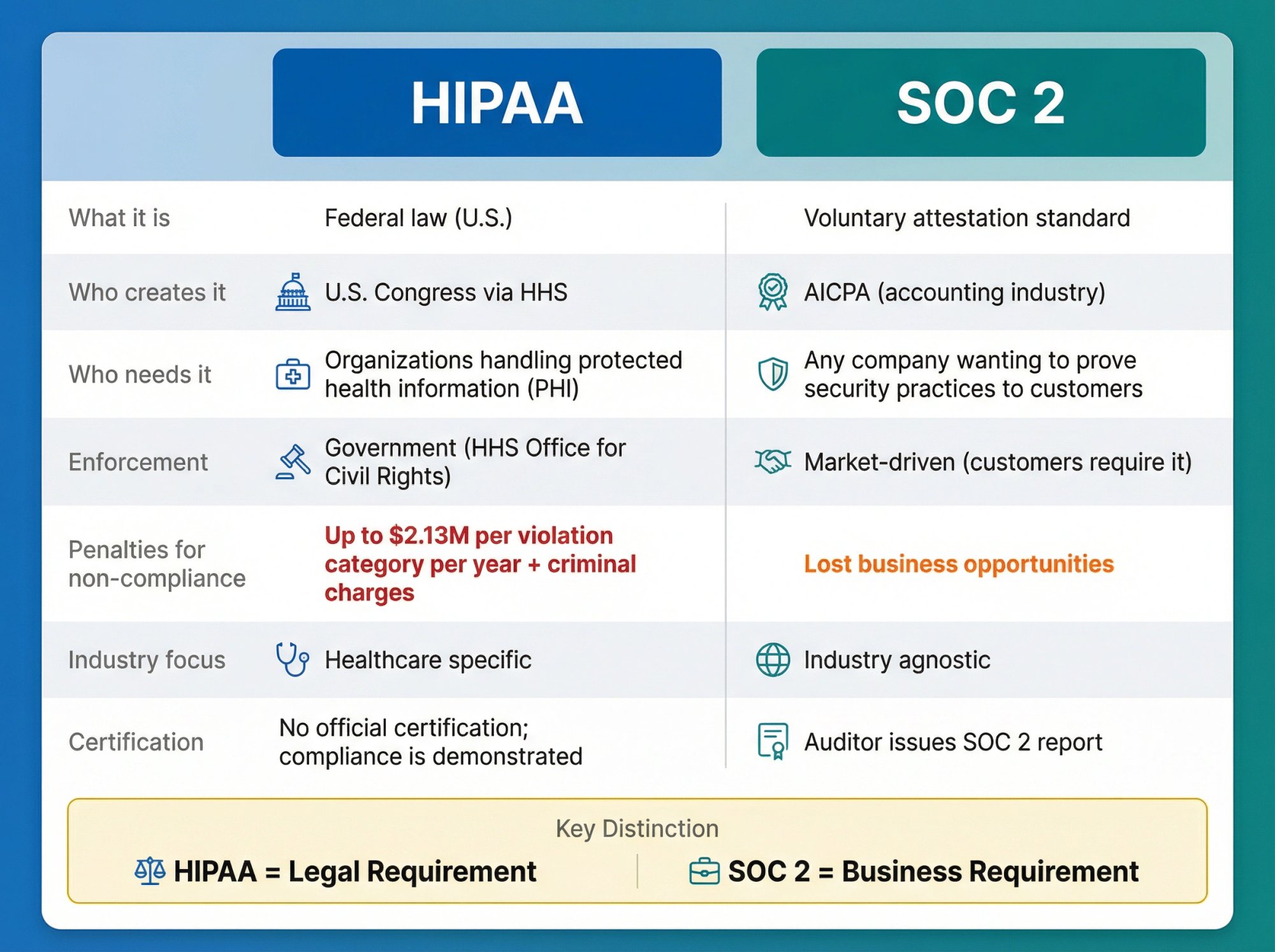
Before we get into the details, here's a quick comparison to orient you:
| Aspect | HIPAA | SOC 2 |
|---|---|---|
| What it is | Federal law (U.S.) | Voluntary attestation standard |
| Who creates it | U.S. Congress via HHS | AICPA (accounting industry) |
| Who needs it | Organizations handling protected health information (PHI) | Any company wanting to prove security practices to customers |
| Enforcement | Government (HHS Office for Civil Rights) | Market-driven (customers require it) |
| Penalties for non-compliance | Up to $2.13 million per violation category per year + criminal charges | Lost business opportunities |
| Industry focus | Healthcare specific | Industry agnostic |
| Certification | No official certification; compliance is demonstrated | Auditor issues SOC 2 report |
The fundamental distinction is simple: HIPAA is a legal requirement if you handle healthcare data. SOC 2 is a business requirement if you want enterprise customers to trust you with their data.
What is HIPAA Compliance and Who Needs It?
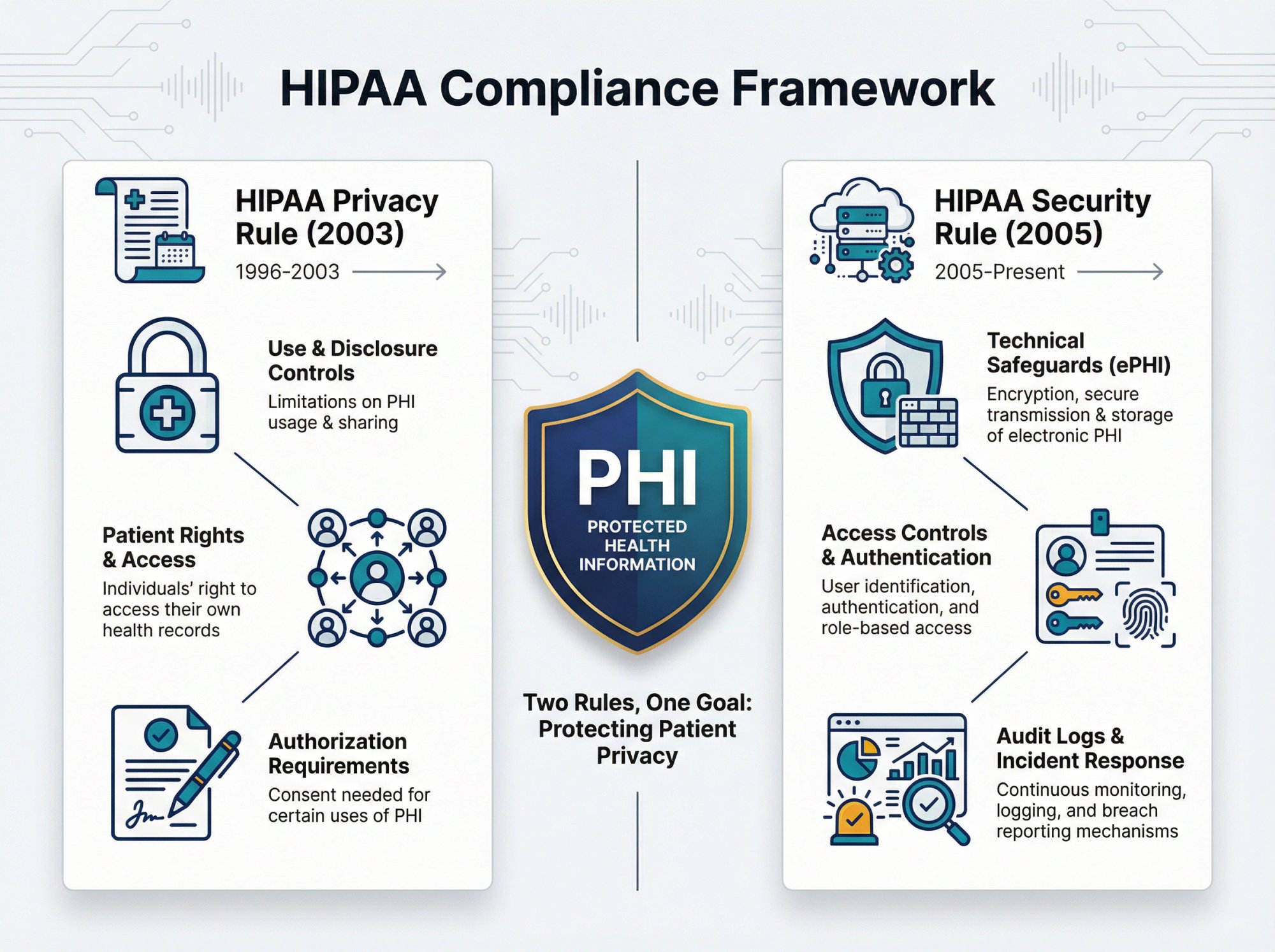
HIPAA (Health Insurance Portability and Accountability Act) became law in 1996. While the original legislation covered health insurance portability, the rules most relevant to tech companies came later with the Privacy Rule (2003) and Security Rule (2005).
The Privacy Rule governs how protected health information (PHI) can be used and disclosed. The Security Rule mandates specific safeguards for electronic PHI (ePHI). Together, they create a framework for protecting patient information.
What counts as PHI?
PHI includes any health information that can identify an individual. The HHS defines 18 specific identifiers, including:
- Names
- Dates (birth, admission, discharge, death)
- Phone numbers, fax numbers, email addresses
- Social Security numbers
- Medical record numbers
- Health plan beneficiary numbers
- Account numbers
- Biometric identifiers
- Full-face photographs
- Any other unique identifying characteristic
If you're combining health information with any of these identifiers, you're dealing with PHI. For a comprehensive list of what you need to verify, check out our HIPAA compliance audit checklist.
What Qualifies as a HIPAA Covered Entity?
HIPAA applies directly to "covered entities," which include:
Healthcare providers: Doctors, clinics, hospitals, pharmacies, nursing homes, or any provider who transmits health information electronically in connection with certain transactions (like billing).Health plans: Health insurance companies, HMOs, employer-sponsored health plans, and government programs like Medicare and Medicaid.Healthcare clearinghouses: Organizations that process nonstandard health information into standard formats.
If your company falls into one of these categories, HIPAA compliance isn't optional. It's the law.
What is a HIPAA Business Associate?
This is where it gets interesting for tech companies. Even if you're not a covered entity, you might be a business associate.
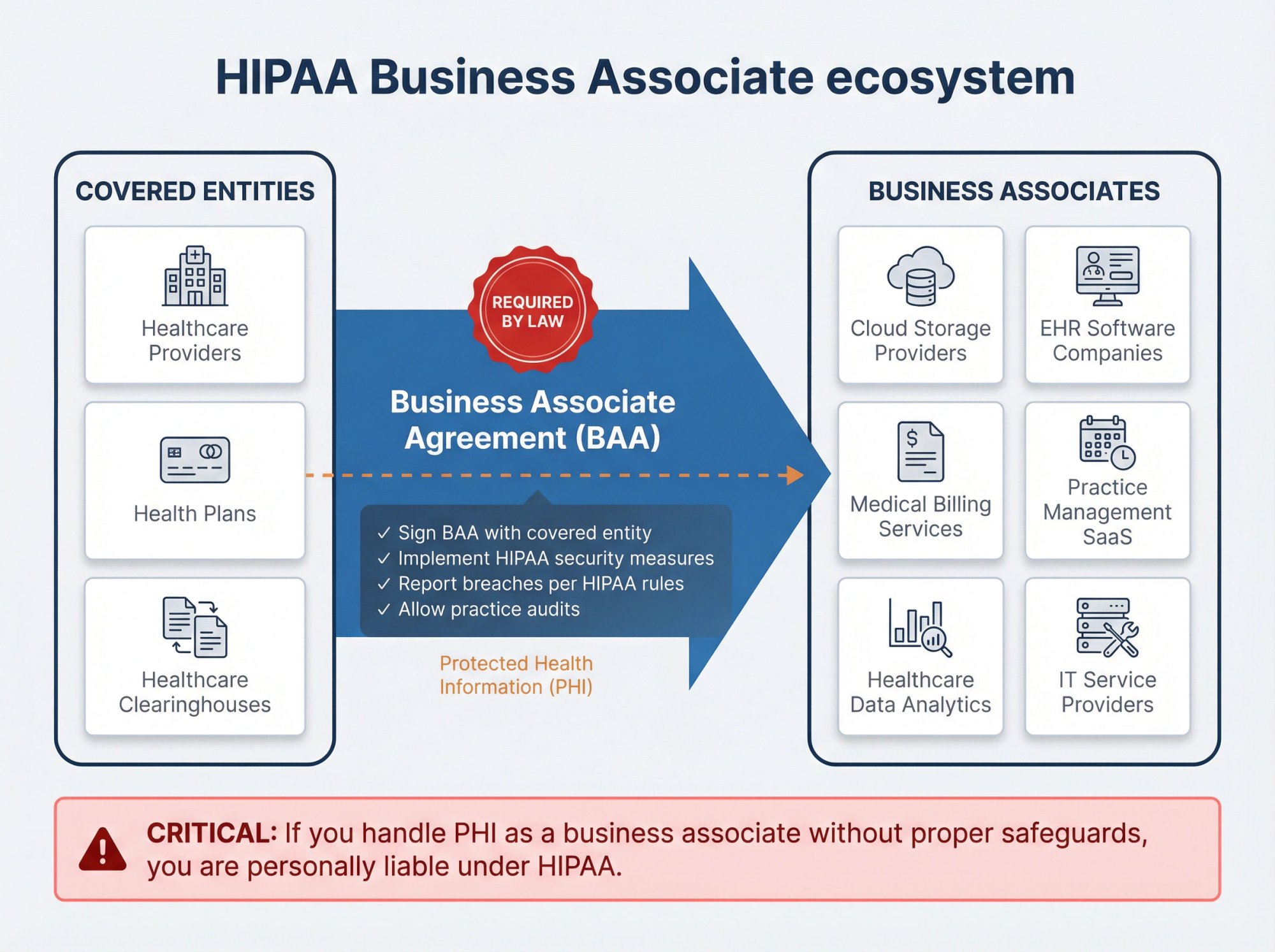
A business associate is any person or organization that performs functions or activities on behalf of a covered entity that involve access to PHI. Common examples include:
- Cloud storage providers hosting patient records
- EHR (Electronic Health Records) software companies
- Medical billing services
- Practice management software providers
- Data analytics companies processing health data
- IT service providers with access to systems containing PHI
If a hospital uses your SaaS product and that product stores, processes, or transmits PHI, you're likely a business associate. This means you need to:
- Sign a Business Associate Agreement (BAA) with the covered entity
- Implement HIPAA-compliant security measures
- Report breaches according to HIPAA requirements
- Allow your practices to be audited
The consequences of being a business associate without knowing it can be severe. If there's a breach and you don't have proper safeguards in place, you're personally liable under HIPAA.
What is SOC 2 and Why Do Companies Need It?
SOC 2 (System and Organization Controls 2) is a completely different animal. Developed by the American Institute of Certified Public Accountants (AICPA), SOC 2 is a voluntary attestation standard that demonstrates your company maintains effective security controls.
Unlike HIPAA, there's no law requiring SOC 2. So why do thousands of companies pursue it every year?
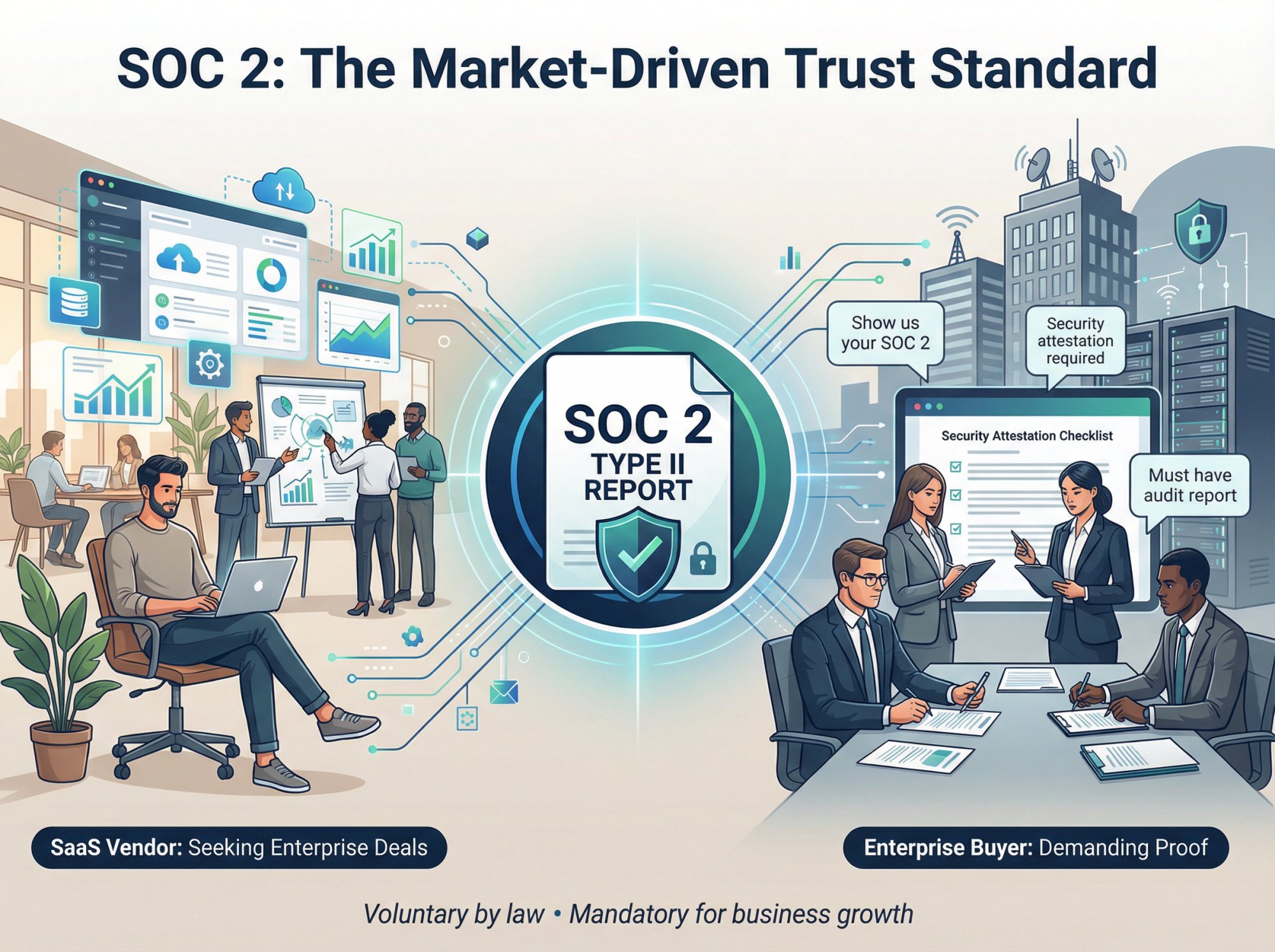
Because enterprise customers demand it.
When a large company evaluates your software, their security team will almost certainly ask for evidence that you protect data responsibly. A SOC 2 report is the standard way to provide that evidence. Without it, you'll often face:
- Lengthy security questionnaires (we're talking hundreds of questions)
- Custom audit requests
- Delayed or blocked deals
- Lost opportunities to competitors who already have SOC 2
In practical terms, SOC 2 has become table stakes for selling to enterprises. It's voluntary in the legal sense, but it's increasingly mandatory for business growth. To understand the specific controls auditors evaluate, review the full SOC 2 compliance requirements.
What are the SOC 2 Trust Service Criteria?
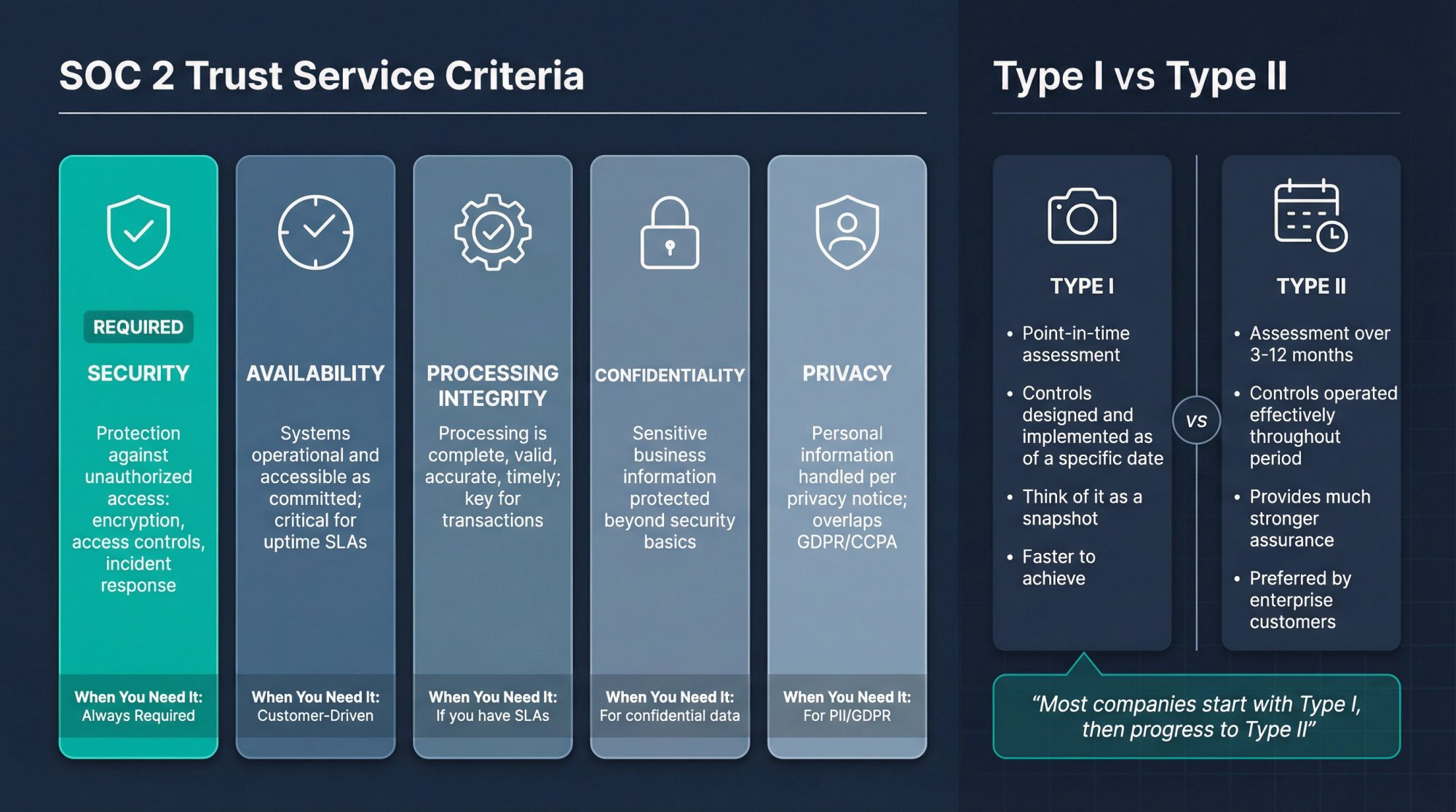
SOC 2 evaluates your organization against five Trust Service Criteria (TSC). Here's what each one covers:
| Criteria | What It Covers | When You Need It |
|---|---|---|
| Security (Required) | Protection against unauthorized access: access controls, encryption, incident response | Always required for any SOC 2 |
| Availability | Systems operational and accessible as committed | If you have uptime SLAs or customers depend on availability |
| Processing Integrity | System processing is complete, valid, accurate, and timely | Critical for financial transactions, analytics |
| Confidentiality | Sensitive business information is protected | When handling confidential data beyond security basics |
| Privacy | Personal information handled per your privacy notice | Overlaps with GDPR/CCPA requirements |
Most companies start with Security (because it's required) and add other criteria based on customer requests or business needs. Our walks you through each criterion step by step.
SOC 2 Type 1 vs Type 2: Which Do You Need?
SOC 2 comes in two flavors, and understanding the distinction matters for your compliance timeline. For a detailed breakdown, see our guide on SOC 2 Type 1 vs Type 2.
Type I: A point-in-time assessment. The auditor evaluates whether your controls are designed appropriately and implemented as of a specific date. Think of it as a snapshot.
Type II: An assessment over a period (typically 3-12 months). The auditor tests whether your controls actually operated effectively throughout that period. This provides much stronger assurance.
Most companies start with Type I because it's faster to achieve. Once you have Type I, you can begin your observation period for Type II while already demonstrating compliance to customers.
The practical difference?Type I says "we have the right controls in place today."Type II says "we've been operating these controls consistently for months, and they actually work."
Enterprise customers generally prefer Type II, but they'll often accept Type I while you work toward Type II.
HIPAA vs SOC 2: What are the Key Differences?
Now that you understand each framework individually, here are the critical differences:
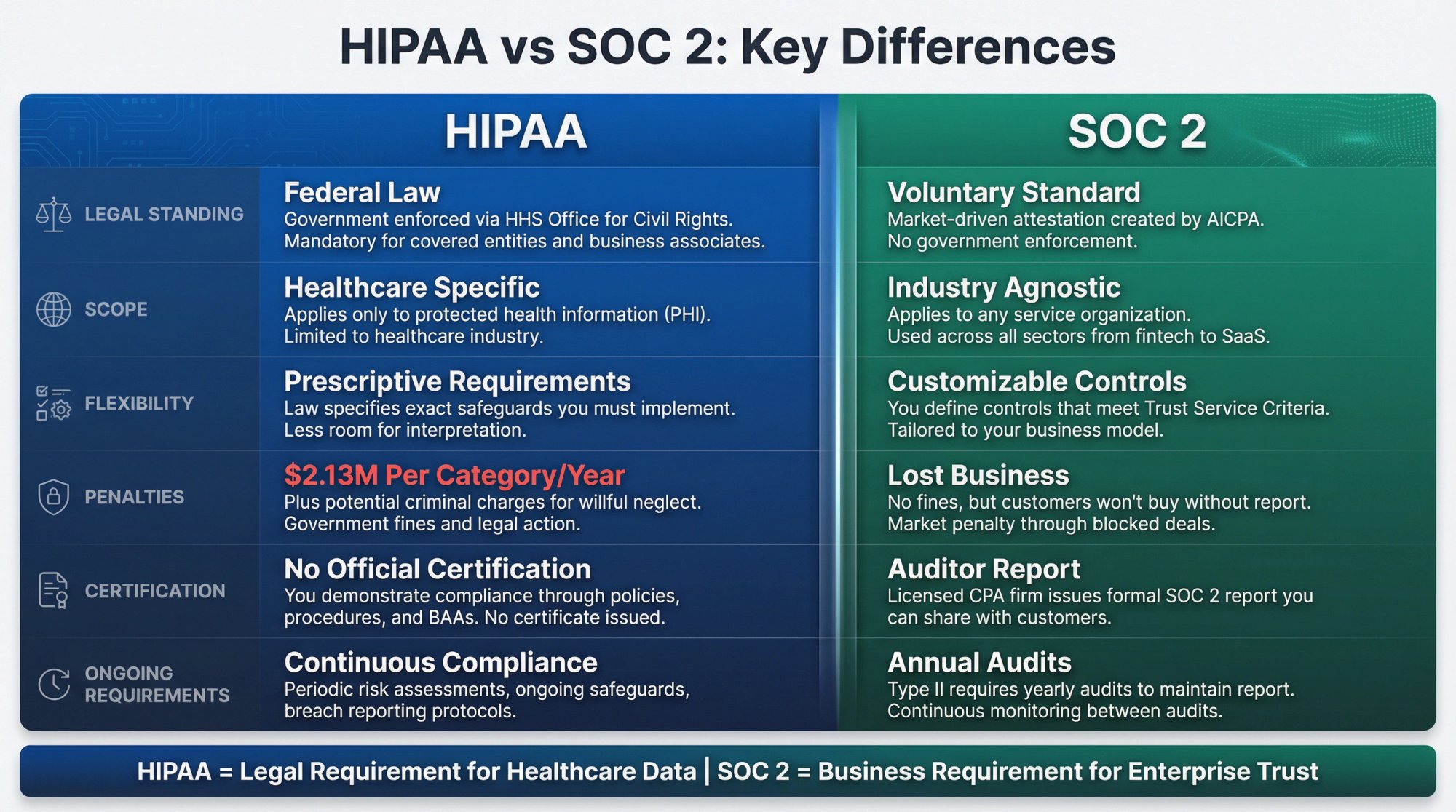
Legal standing: HIPAA is federal law enforced by the government. If you violate it, the HHS Office for Civil Rights can investigate and penalize you. SOC 2 has no government enforcement. The "penalty" for not having SOC 2 is simply that customers won't do business with you.
Scope: HIPAA applies specifically to healthcare information. SOC 2 is industry-agnostic and can apply to any service organization. A fintech company handling payment data might need SOC 2 but would never need HIPAA. A telehealth platform would likely need both.
Flexibility: HIPAA requirements are prescriptive. The law specifies certain safeguards you must implement. SOC 2 is more flexible. You define your controls, and the auditor evaluates whether they meet the Trust Service Criteria. This means SOC 2 can be tailored to your specific business.
Penalties: HIPAA violations can result in fines up to $2.13 million per violation category per year, plus potential criminal charges for willful neglect. SOC 2 "failures" just mean you don't receive the report and can't show it to customers. There's no fine, but there's significant business impact.
Certification vs. compliance: Technically, there's no such thing as "HIPAA certified." You're either compliant or you're not, and you demonstrate compliance through policies, procedures, and evidence. SOC 2 results in an actual report from a licensed CPA firm that you can share with customers.
Ongoing requirements: Both require ongoing effort. HIPAA requires continuous compliance and periodic risk assessments. SOC 2 Type II requires annual audits to maintain your report. Neither is a one-and-done achievement.
Do You Need HIPAA, SOC 2, or Both?
Here are the most common scenarios so you can identify where you fit.
B2B SaaS Companies Without Healthcare Data
Example: A project management tool, CRM, or marketing platform that serves various industries but doesn't handle any health information.
What you need: SOC 2 (probably starting with Type I, then Type II)
If your customers never share PHI with you and you don't process health data, HIPAA doesn't apply. But if you're selling to enterprises, they'll expect SOC 2 as proof that you take security seriously.
The good news: SOC 2 positions you well for growth. Once you have it, you can compete for enterprise deals with confidence.
Healthcare Companies Not Selling to Enterprises
Example: A small medical practice management software serving independent clinics, or a healthcare data analytics tool for research.
What you need: HIPAA compliance (mandatory)
If you're handling PHI as a business associate or covered entity, HIPAA is non-negotiable. You need to implement the required safeguards, sign BAAs with covered entities, and maintain compliance documentation.
SOC 2 might not be necessary yet if your customers aren't asking for it. But keep in mind: as you grow and target larger healthcare organizations, they may start requiring SOC 2 too.
Healthcare SaaS Selling to Enterprise Customers
Example: An EHR platform, telehealth solution, healthcare analytics tool, or any SaaS product that handles PHI and targets hospital systems, large medical groups, or health plans.
What you need: Both HIPAA and SOC 2
This is increasingly common. Enterprise healthcare customers want to see that you're HIPAA compliant (because you'll be handling their PHI) and that you meet general security best practices (SOC 2).
The good news? There's significant overlap between HIPAA and SOC 2 controls, which means you can work toward both more efficiently than pursuing them separately.
HIPAA and SOC 2 Control Overlap: Which Requirements Align?
If you need both frameworks, you'll be pleased to know they share a lot of common ground. Studies suggest approximately 85% of HIPAA Security Rule requirements overlap with SOC 2 Security criteria.
Here's where the frameworks align:
| Control Area | HIPAA Requirement | SOC 2 Requirement | One Solution Satisfies Both |
|---|---|---|---|
| Access controls | Unique user ID, automatic logoff, encryption | Limit access to authorized users | A strong |
| Risk assessments | Periodic risk assessments for vulnerabilities | Risk management process | One comprehensive assessment via |
| Audit logging | Record and examine activity in PHI systems | Monitoring and logging requirements | Same logs, two frameworks |
| Incident response | Procedures to identify and respond to incidents | Incident management processes | One |
| Employee training | Security awareness for workforce | Personnel trained on security | Train once, document for both |
| Physical safeguards | Facility access controls, workstation security | Physical security controls | Same controls, dual compliance |
The practical implication: a unified compliance program is far more efficient than treating HIPAA and SOC 2 as separate projects. You can implement controls once and map them to both frameworks. If you're also considering , the overlap extends even further.
At Comp AI, we build this unified approach into our platform. When you implement a control for HIPAA, we automatically map it to the relevant SOC 2 criteria. This eliminates duplicate work and gets you compliant with both frameworks faster.
HIPAA vs SOC 2 Costs and Timelines Compared
So what does it actually take to achieve compliance with each framework?
How Much Does HIPAA Compliance Cost?
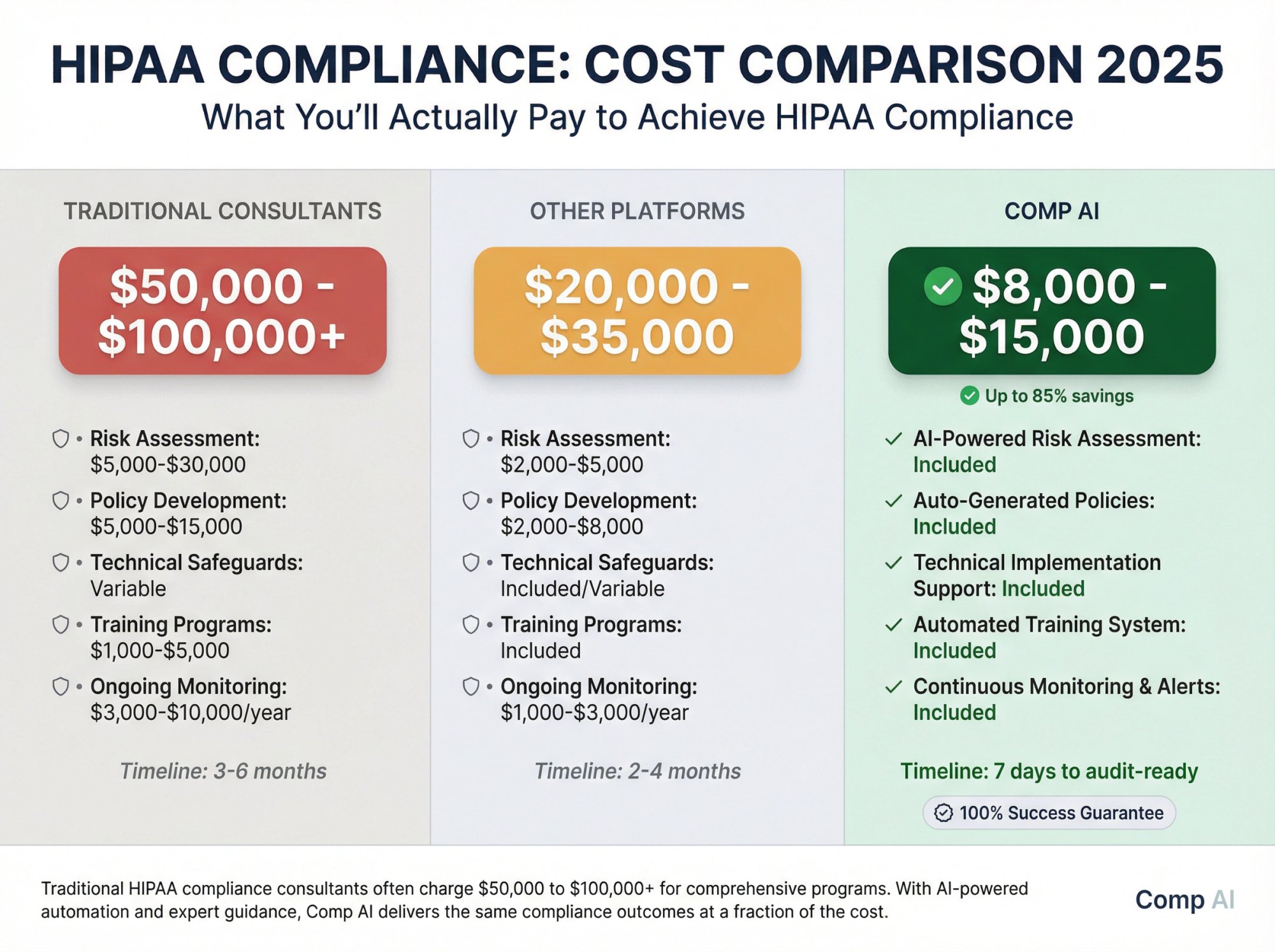
Traditional HIPAA compliance involves several cost components:
| Component | Typical Cost Range | What's Included |
|---|---|---|
| Risk assessment | $5,000 - $30,000 | Consultant-led thorough HIPAA risk assessment |
| Policy development | $5,000 - $15,000 | Complete set of HIPAA-compliant policies and procedures |
| Technical safeguards | Variable | Encryption, access controls, backup systems, monitoring |
| Training | $1,000 - $5,000 | Workforce training programs |
| Ongoing monitoring | $3,000 - $10,000/year | Continuous compliance monitoring, annual risk assessments |
Traditional timeline: 3-6 months for initial compliance, depending on your starting point and system complexity.
Price with Comp AI: $8,000-15,000Price with others: $20,000+Traditional consultants often charge $50,000 to $100,000+ for HIPAA compliance programs. With Comp AI, you get the same outcome at a fraction of the cost.
How Much Does SOC 2 Certification Cost?
SOC 2 costs typically break down as follows:
| Component | Typical Cost Range | What's Included |
|---|---|---|
| Readiness assessment | $5,000 - $20,000 | Gap identification and audit preparation |
| Platform or consultant fees | $15,000 - $50,000 | Tools, expertise, control implementation, evidence management |
| Auditor fees | $15,000 - $50,000 | Actual SOC 2 audit (Type I costs less than Type II) |
| Annual renewal | Similar to auditor fees | Maintaining your SOC 2 report |
Traditional timeline: 6-12 months for first-time SOC 2 Type II, including readiness work and observation period. For a detailed breakdown, explore our or use the for a personalized estimate.
Price with Comp AI: $8,000-15,000Price with others: $50,000+This includes platform fees plus the audit itself. Traditional approaches combining consultants and auditors can easily exceed $100,000.
How Automation Reduces HIPAA and SOC 2 Compliance Time
This is where modern compliance platforms fundamentally change the equation.
Traditional compliance relies heavily on manual work: gathering evidence screenshots, writing policies from scratch, chasing colleagues for documentation, and coordinating with auditors over months of back-and-forth.
With AI-powered automation, most of that manual work disappears. Automated evidence collection happens automatically through integrations with your existing tools. Policies are generated based on your specific tech stack. The audit preparation that used to take months can happen in days.
At Comp AI, we've helped companies go from zero to HIPAA-ready in as little as 7 days, and SOC 2 Type I ready in 24 hours. That's not marketing fluff. One CTO who switched to us after spending four months with another platform was audit-ready in just a couple of days.
How Comp AI Helps You Achieve HIPAA and SOC 2 Compliance
We built Comp AI because we lived the pain of traditional compliance. Months of manual work, confusing requirements, and expensive consultants just to check a box that shouldn't slow your business down.
Here's how we approach HIPAA and SOC 2 differently:
AI-powered automation: Our AI agents automatically collect evidence from your systems, generate policies tailored to your tech stack, and monitor for compliance gaps 24/7. Instead of you spending weeks gathering screenshots and documentation, the platform does it while you sleep.
Done-for-you onboarding: We don't just hand you software and wish you luck. Our team configures your integrations, customizes your policies, and guides you through every step. Customers regularly tell us it feels like having an expert compliance team without the headcount.
Speed that actually delivers: HIPAA-ready in 7 days. SOC 2 Type I ready in 24 hours. SOC 2 Type II ready in 14 days (then you wait for the observation period, but you're already operating in compliance). These aren't aspirational goals. They're what we deliver routinely.
100% success rate guarantee: We're so confident in our process that we guarantee you'll pass your audit. To date, every single customer who has completed an audit through Comp AI has passed.
Unified compliance management: Need both HIPAA and SOC 2? Our platform maps controls across frameworks automatically. Implement once, satisfy both requirements. No duplicate work, no confusion about which control serves which framework.
Pre-vetted auditor network: We've partnered with auditors who understand modern, automated compliance programs. This means faster audits with fewer questions and no surprises.
If you're tired of compliance blocking deals or draining engineering resources, book a demo with our team. We'll show you exactly how fast you can go from "we need compliance" to "here's our SOC 2 report."
HIPAA vs SOC 2 FAQs
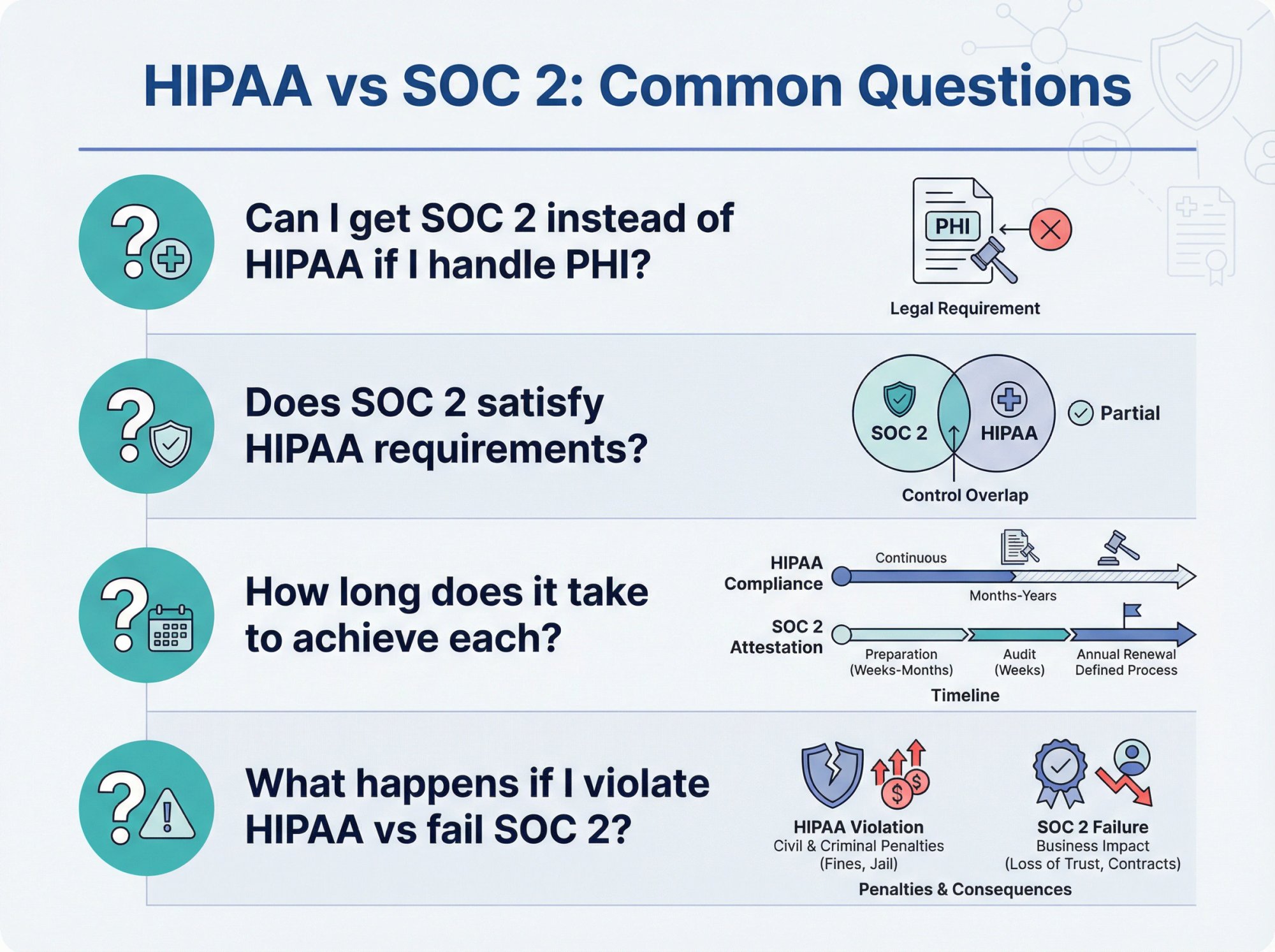
Can I get SOC 2 instead of HIPAA if I handle PHI?
No. If you handle protected health information as a covered entity or business associate, HIPAA compliance is a legal requirement. SOC 2 doesn't satisfy HIPAA obligations. You need HIPAA for the legal requirement and may also need SOC 2 for business reasons, but one doesn't replace the other.
Does SOC 2 satisfy HIPAA requirements?
Not directly. While there's significant overlap in controls (access management, encryption, incident response), SOC 2 is focused on general security practices while HIPAA has specific requirements for protecting health information. But if you have SOC 2, you're likely already implementing many controls that HIPAA requires. You'll just need to ensure you've addressed the HIPAA-specific requirements and have proper BAAs in place.
How long does it take to achieve HIPAA compliance vs SOC 2?
Traditional timelines: HIPAA takes 3-6 months, SOC 2 Type II takes 6-12 months. With modern automation platforms like Comp AI, you can be HIPAA-ready in 7 days and SOC 2 Type I ready in 24 hours. Type II still requires the 3-month observation period, but you can start that immediately.
What happens if I violate HIPAA vs fail a SOC 2 audit?
HIPAA violations can result in fines up to $2.13 million per violation category per year, investigation by the HHS Office for Civil Rights, and potential criminal charges for willful neglect. Failing a SOC 2 audit means you simply don't receive the report. There are no fines, but you can't demonstrate compliance to customers, which often means lost business.
Can I do HIPAA and SOC 2 at the same time?
Yes, and it's often more efficient to pursue them together. About 85% of controls overlap, so you can implement controls once and map them to both frameworks. Comp AI automatically handles this mapping, so you're not duplicating effort.
Do I need both Type I and Type II SOC 2?
Not necessarily. Type I is faster to achieve and provides a point-in-time snapshot of your controls. Many companies start with Type I to demonstrate initial compliance and then pursue Type II over time. Enterprise customers generally prefer Type II because it shows sustained compliance over a period, but most will accept Type I initially.
How do I know if my company is a business associate under HIPAA?
Ask yourself: Do you create, receive, maintain, or transmit PHI on behalf of a covered entity (healthcare provider, health plan, or clearinghouse)? If yes, you're likely a business associate. Common examples include cloud storage providers, EHR software companies, billing services, and IT providers with access to systems containing PHI. When in doubt, consult with a healthcare attorney or compliance expert.
What's the cheapest way to get HIPAA and SOC 2 compliant?
The cheapest route depends on your definition of "cheap." You can technically DIY compliance with free templates and self-study, but the time investment is enormous (hundreds of hours) and the risk of missing requirements is high. The most cost-effective approach for most companies is using an automated compliance platform that combines software automation with expert guidance. With Comp AI, you can achieve both HIPAA and SOC 2 compliance for a fraction of traditional consultant costs while spending days instead of months on the process.
Compliance doesn't have to be the roadblock that slows your growth. Whether you need HIPAA, SOC 2, or both, the path forward is clearer than it's ever been.
The real question isn't whether you can afford to invest in compliance. It's whether you can afford to keep losing deals and delaying partnerships while your competitors show up with their certifications ready to go.
If you're ready to stop letting compliance hold you back, reach out to our team at Comp AI. We'll help you figure out exactly which frameworks you need and get you compliant faster than you thought possible.