When to Get SOC 2: Complete Timing Guide for Startups
Not sure when to get SOC 2? Learn the 7 signals that mean it's time, plus how modern tools can get you certified in weeks instead of months.
You're in a sales call with a Fortune 500 prospect. The conversation is going great. They love your product, the pricing works, and the champion is ready to push the deal through. Then comes the question: "Can you send over your SOC 2 report?"
If you don't have one, what happens next isn't pretty. The deal stalls. Legal gets involved. Weeks turn into months while your competitor (who does have SOC 2) swoops in.
This scenario plays out constantly in B2B software sales. And it raises a critical question that every growing company eventually faces: when is the right time to get SOC 2?
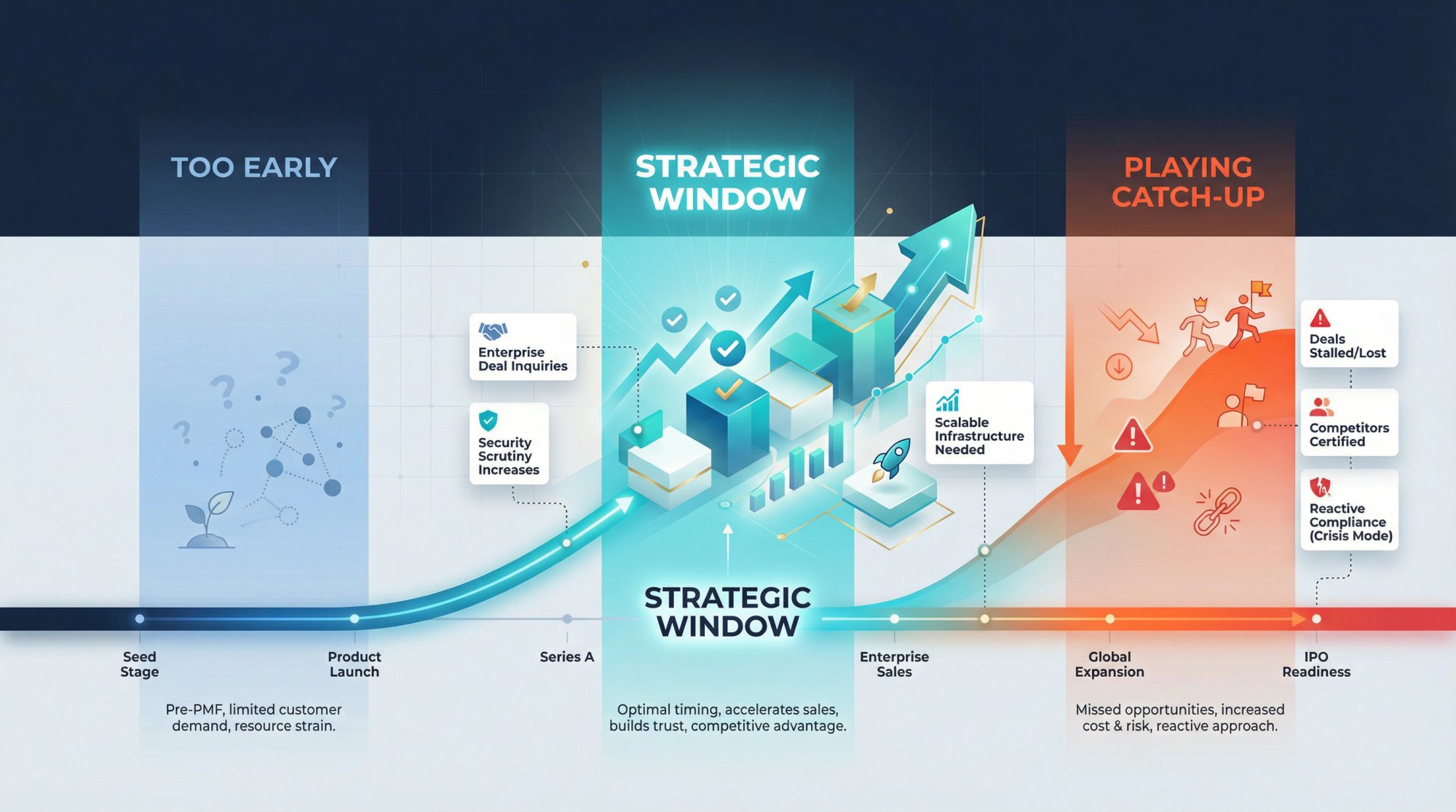
The answer isn't "immediately" for everyone. But it's also not "wait until someone asks." Getting the timing right can mean the difference between accelerating growth and scrambling to catch up.
This guide will give you a clear framework for deciding when to pursue SOC 2 certification, what triggers should prompt immediate action, and how to move quickly once you've made the decision.
What Is SOC 2 and Why Does Timing Matter?
SOC 2 (System and Organization Controls 2) is a security framework developed by the American Institute of CPAs (AICPA). It evaluates how well a company protects customer data based on five trust service criteria: security, availability, processing integrity, confidentiality, and privacy.
For B2B software companies, SOC 2 has become the de facto trust currency. It signals to enterprise customers that you take security seriously, that you have documented controls in place, and that an independent auditor has verified your practices.
Here's what makes timing so important: SOC 2 isn't just an operational checkbox. It's a strategic asset that directly affects your ability to close deals, raise funding, and compete in your market.
Get it too early and you've spent resources before you really needed them. Get it too late and you've already lost opportunities you didn't even know about (because prospects quietly moved on to competitors who had their compliance in order).
The goal is to time your SOC 2 pursuit so that you have the certification before it becomes a blocker, without starting so early that it distracts from finding product-market fit.
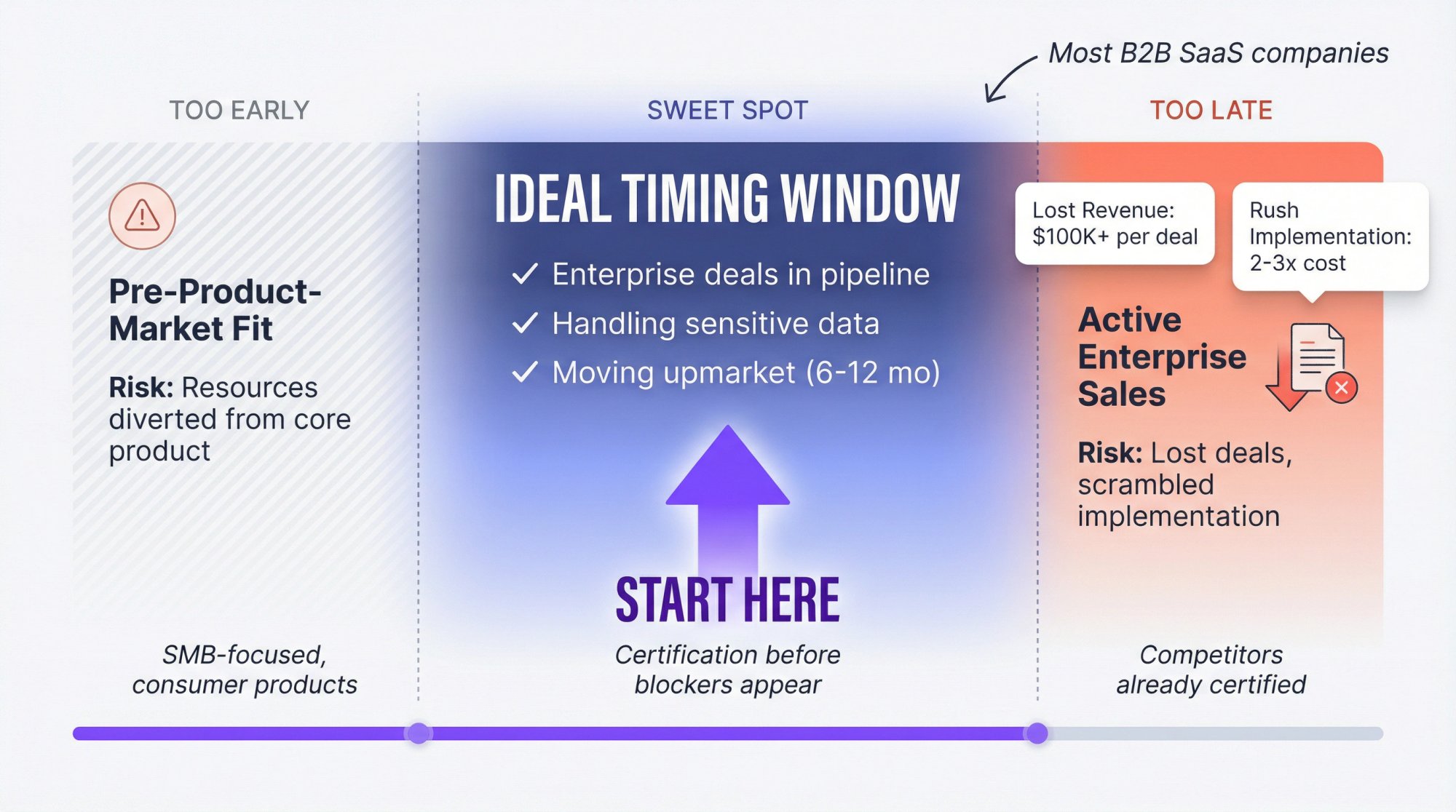
7 Signs You Need SOC 2 Right Now
Certain signals indicate that SOC 2 should move from "eventually" to "immediately" on your priority list. If you're experiencing any of these, it's time to start the process:
1. Enterprise Prospects Are Requesting Security Documentation
This is the most obvious trigger. When prospects in your pipeline start requesting security questionnaires, SOC 2 reports, or evidence of your security controls, you've hit the inflection point.
These requests often come from security teams or procurement departments during vendor evaluation. Without SOC 2, you'll spend hours (sometimes days) manually answering questionnaires and providing ad-hoc documentation. And even then, some enterprise buyers will simply move on because the risk isn't worth it without third-party verification.
2. You're Losing RFPs Due to Compliance Requirements
Enterprise RFPs frequently include mandatory compliance requirements. "Must have current SOC 2 Type II" isn't uncommon language. If you're seeing these requirements and having to pass on opportunities, you're leaving revenue on the table.
3. Investors Are Asking About Your Security Posture
Sophisticated investors, particularly those backing B2B SaaS companies, increasingly evaluate security and compliance during due diligence. They know that their portfolio companies will need SOC 2 to scale, and they want to see that you're either compliant or have a clear path to compliance.
If investors are asking about your security practices, they're signaling that compliance matters for your growth trajectory.
4. You're Selling to Healthcare, Fintech, or Government
Even if your company isn't directly in healthcare or financial services, serving customers in those industries often creates compliance requirements by association. Healthcare organizations need assurance that their vendors protect patient information. Financial institutions have their own regulatory requirements that flow down to service providers.
If your target market includes healthcare, fintech, insurance, or government, SOC 2 becomes essential, not optional. For healthcare-adjacent companies, you may also need to consider HIPAA compliance requirements alongside SOC 2.
5. Your Competitors Already Have SOC 2
When prospects can choose between your product (no SOC 2) and a competitor's product (with SOC 2), you're at an immediate disadvantage. This is especially true in crowded markets where buyers are looking for reasons to narrow their evaluation list.
Compliance becomes a differentiator only when you have it. Without it, you're simply not in the conversation for certain deals.
6. You're Processing Sensitive Customer Data
As your product matures and customers trust you with more sensitive information, your obligation to protect that data increases proportionally. There's often a threshold where the data you're handling makes SOC 2 practically necessary, even if no one has explicitly asked for it.
Payment information, personal identifiable information (PII), healthcare data, financial records: if you're touching any of these, SOC 2 isn't just about sales enablement. It's about responsible data stewardship.
7. You're Moving Upmarket in the Next 12 Months
If your roadmap involves moving upmarket over the next 12 to 18 months, don't wait until you get there to start SOC 2. The certification process takes time (though not as much as it used to), and you want it in place before you're actively pursuing enterprise deals.
Think of SOC 2 as infrastructure for growth. You build it before you need it, not while customers are waiting.
What Happens If You Wait Too Long?
The temptation to delay SOC 2 is understandable. You're focused on building product, closing deals, and managing a thousand other priorities. Compliance feels like it can wait.
But the costs of waiting often exceed the costs of acting proactively:
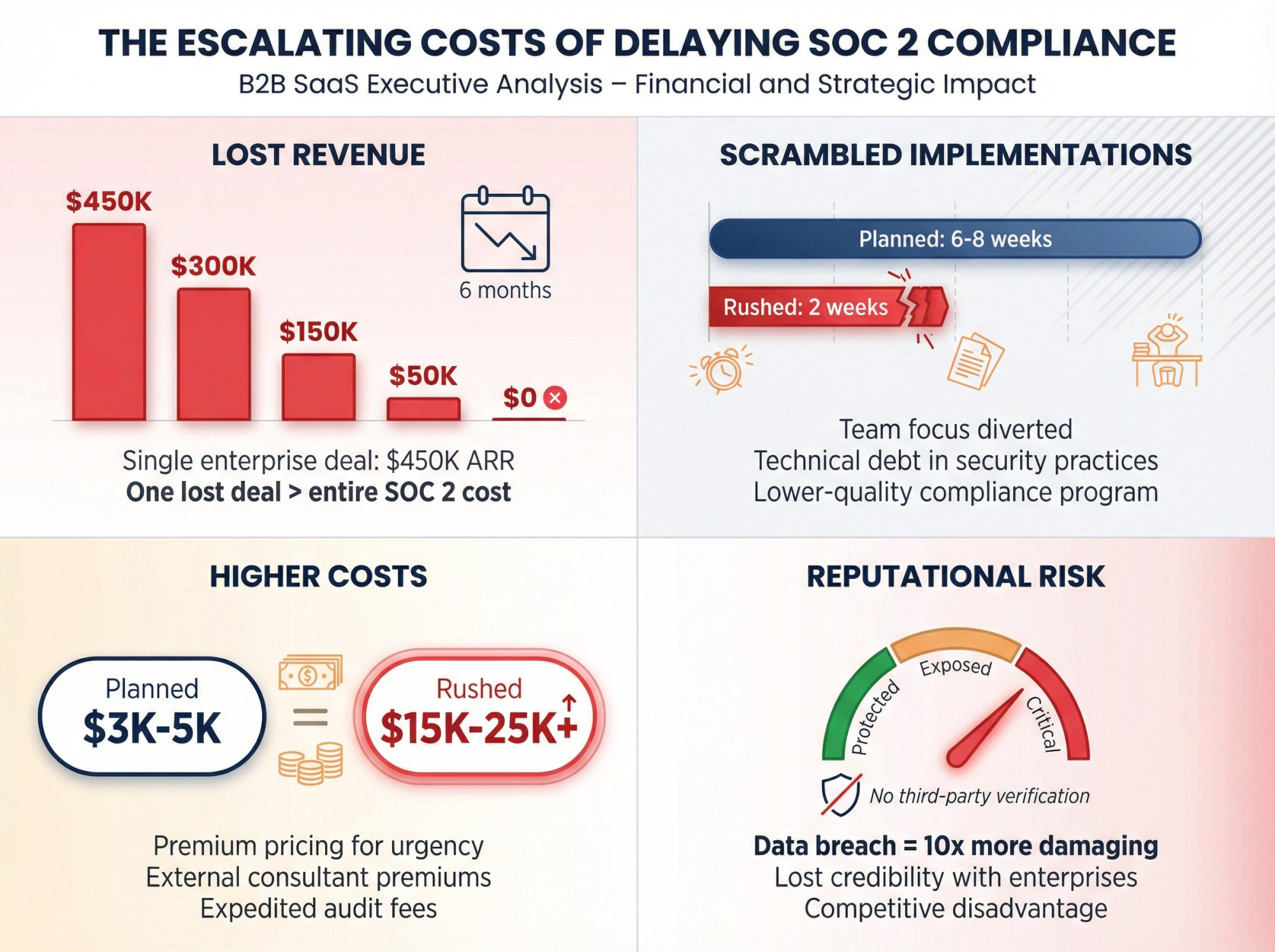
Lost Revenue
Every deal that stalls or dies because of missing compliance represents lost revenue. In B2B sales, these aren't small numbers. A single enterprise deal can be worth hundreds of thousands of dollars annually. One lost deal often exceeds the entire cost of getting SOC 2 certified.
Scrambled Implementations
When you finally get that enterprise opportunity but don't have SOC 2, you're faced with an impossible choice: rush through compliance under pressure, or watch the deal slip away.
Rushed implementations are expensive and stressful. They pull your team's focus from other priorities, create technical debt in your security practices, and often result in a lower-quality compliance program. If you find yourself in this situation, emergency SOC 2 compliance options exist, but prevention is always better than scrambling.
Higher Costs
Urgency costs money. Need an audit done in two weeks instead of six? That premium pricing adds up. Need external help because your team is already stretched? Those consultants charge more for expedited work.
Companies that plan ahead and execute compliance on their own timeline consistently pay less than those scrambling to catch up.
Reputational Risk
Every month you operate without proper security controls is a month you're exposed to potential incidents. A data breach or security incident is exponentially more damaging without SOC 2. Not only do you face the direct costs of the incident, but you also lose the credibility that comes from having independently verified controls.
Is It Too Early for Your Company to Get SOC 2?
Not every company needs to pursue SOC 2 immediately. There are legitimate reasons to wait:
Pre-Product-Market Fit
If you haven't validated your core product and business model, spending significant resources on compliance might be premature. You need enough stability in your product and target market to ensure the controls you implement will remain relevant.
That said, "pre-PMF" isn't a blanket exemption. If your product inherently handles sensitive data or your initial customers are enterprises, you may need compliance earlier than typical.
Very Early Stage Without Enterprise Focus
A two-person startup selling to SMBs probably doesn't need SOC 2 in year one. The decision should be driven by your target market and sales motion. If enterprises aren't in your current or near-term plans, you can likely wait.
Resource Constraints That Would Cripple Core Operations
If pursuing SOC 2 would genuinely prevent you from building and selling your product, timing might not be right. But be honest with yourself here. Modern compliance platforms have made the resource requirements dramatically lower than they used to be. What once took 6 to 12 months and significant engineering time can now be done in weeks with the right approach.

SOC 2 Type 1 vs Type 2: Which Should You Get First?
Understanding the difference between Type I and Type II reports helps you make better timing decisions:
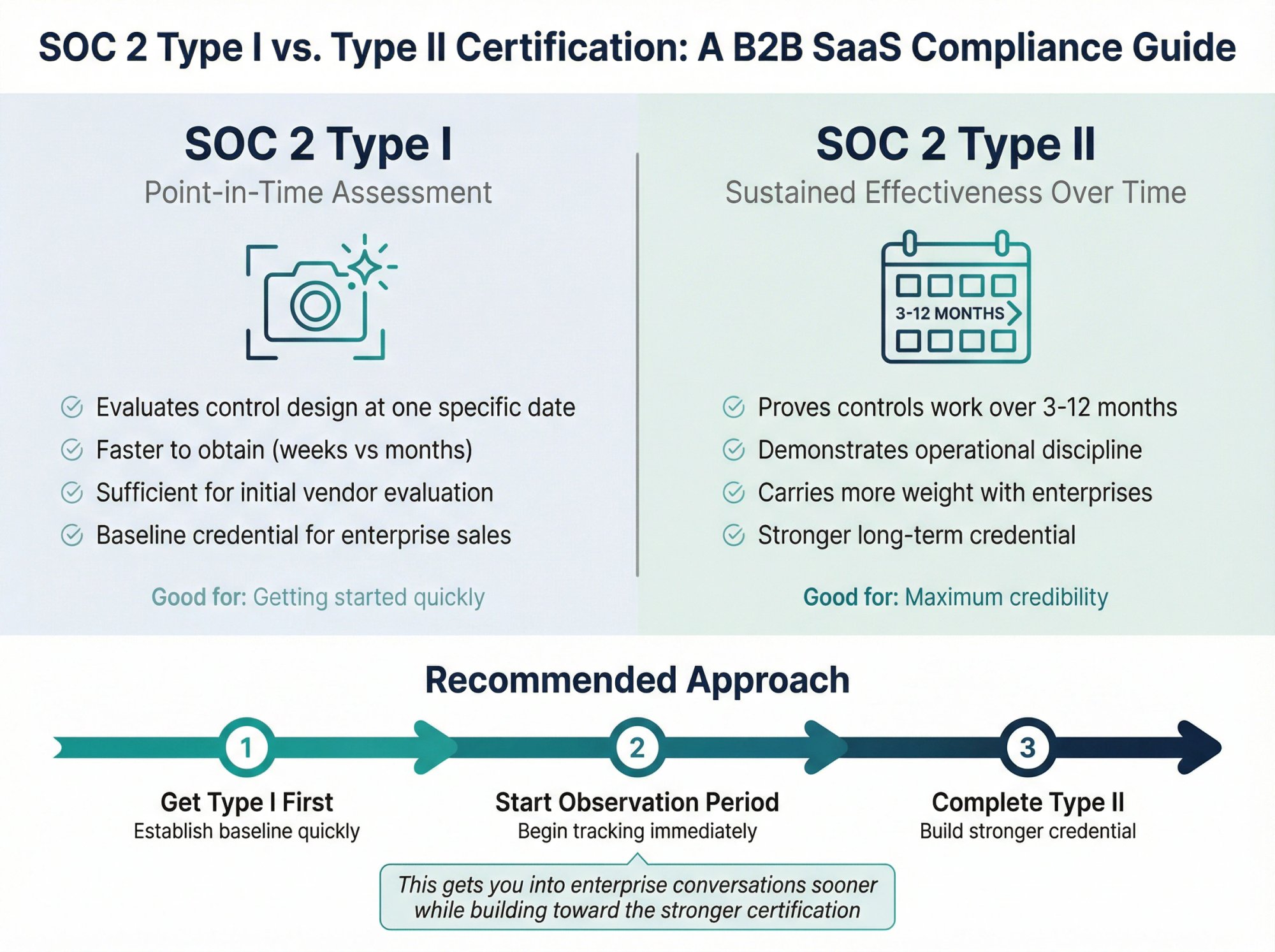
Type I: Point-in-Time Assessment
A SOC 2 Type I report evaluates whether your controls are properly designed and implemented at a specific point in time. It's a snapshot that says "as of this date, these controls were in place and appropriately designed."
Type I is faster to obtain and serves as a solid starting credential. For many enterprise prospects, a Type I report is sufficient to satisfy initial vendor evaluation requirements.
Type II: Operational Effectiveness Over Time
A SOC 2 Type II report goes further. It evaluates not just whether your controls are designed properly, but whether they operated effectively over a period of time (typically 3 to 12 months, with 3 months being the minimum observation period).
Type II carries more weight because it demonstrates sustained operational discipline, not just a point-in-time setup.
The Recommended Approach
For most companies, the best strategy is:
- Get Type I first to establish a baseline credential quickly
- Begin your observation period immediately after Type I
- Complete Type II once the observation period ends
This approach gets you into enterprise conversations sooner (with Type I) while building toward the stronger credential (Type II).
With Comp AI, you can be audit-ready for Type I in as little as 24 hours, which means you're not choosing between speed and thoroughness. You're getting both.
How Long Does SOC 2 Take in 2025?
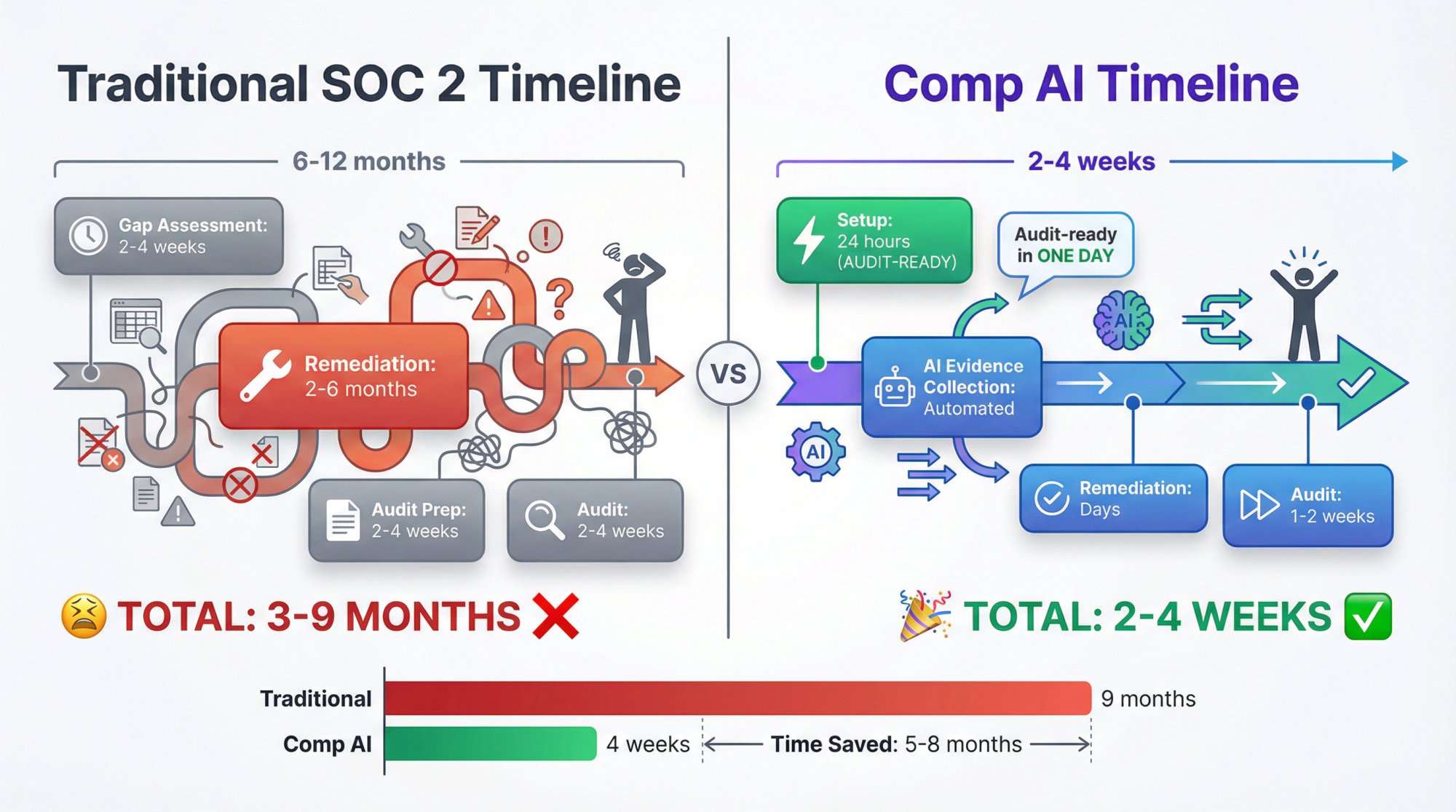
Traditional timelines for SOC 2 look something like this:
| Phase | Traditional Timeline |
|---|---|
| Gap Assessment | 2-4 weeks |
| Remediation | 2-6 months |
| Audit Preparation | 2-4 weeks |
| Audit | 2-4 weeks |
| Total (Type I) | 3-9 months |
| Observation Period (Type II) | 3-12 months additional |
These numbers assume manual processes, spreadsheet tracking, and traditional consulting approaches. They're based on how compliance was done before modern automation tools existed.
Modern approaches look dramatically different:
| Phase | With Comp AI |
|---|---|
| Gap Assessment | Hours |
| Remediation | Days to weeks |
| Audit Preparation | Automated |
| Audit | 1-2 weeks |
| Total (Type I) | 2-6 weeks |
The difference comes from automation handling the tedious work: evidence collection, policy generation, control mapping, and continuous monitoring. Instead of your team spending hundreds of hours gathering screenshots and filling spreadsheets, AI agents handle the grunt work while humans focus on actual security decisions.
At Comp AI, we've taken this even further. Our customers become audit-ready in as little as 24 hours, with full SOC 2 certification achievable in under 4 weeks. That's not marketing hype. It's what happens when you combine AI-powered automation with hands-on expert support. Use our SOC 2 timeline calculator to get a personalized estimate for your situation.
How to Decide If You Need SOC 2: A Practical Framework
Use this framework to assess whether now is the right time for SOC 2:
Are Deals Being Blocked by Compliance?
Answer these questions:
- Have you lost or delayed a deal because of missing compliance? (Yes = pursue SOC 2)
- Are prospects asking for security documentation during sales? (Yes = pursue SOC 2)
- Are you excluding yourself from RFPs due to compliance requirements? (Yes = pursue SOC 2)
Do Your Competitors Have SOC 2?
- Do your main competitors have SOC 2? (Yes = you're already behind)
- Is compliance a selling point in your market? (Yes = pursue SOC 2)
Where Is Your Growth Headed?
- Will you be selling to enterprises in the next 12 months? (Yes = start now)
- Are you raising funding where compliance matters? (Yes = pursue SOC 2)
- Is your data sensitivity increasing? (Yes = pursue SOC 2)
Decision Matrix
| Situation | Recommendation |
|---|---|
| Enterprise deals blocked by compliance | Start immediately |
| Competitors have SOC 2, you don't | Start immediately |
| Moving upmarket in 6-12 months | Start within 60 days |
| Handling sensitive data, no compliance | Start within 60 days |
| Early stage, SMB focus, no requests | Revisit in 6 months |
| Pre-PMF, consumer product | Not a current priority |
Before starting, use our to understand exactly where you stand and what gaps need addressing.
How Comp AI Gets You SOC 2 Certified in Weeks
We built Comp AI because we saw too many companies struggle with the compliance decision. Either they started too late and scrambled, or they started at the right time but the process took forever and consumed way too many resources.
Our approach is different. Here's what makes it work:
How AI Automates Evidence Collection
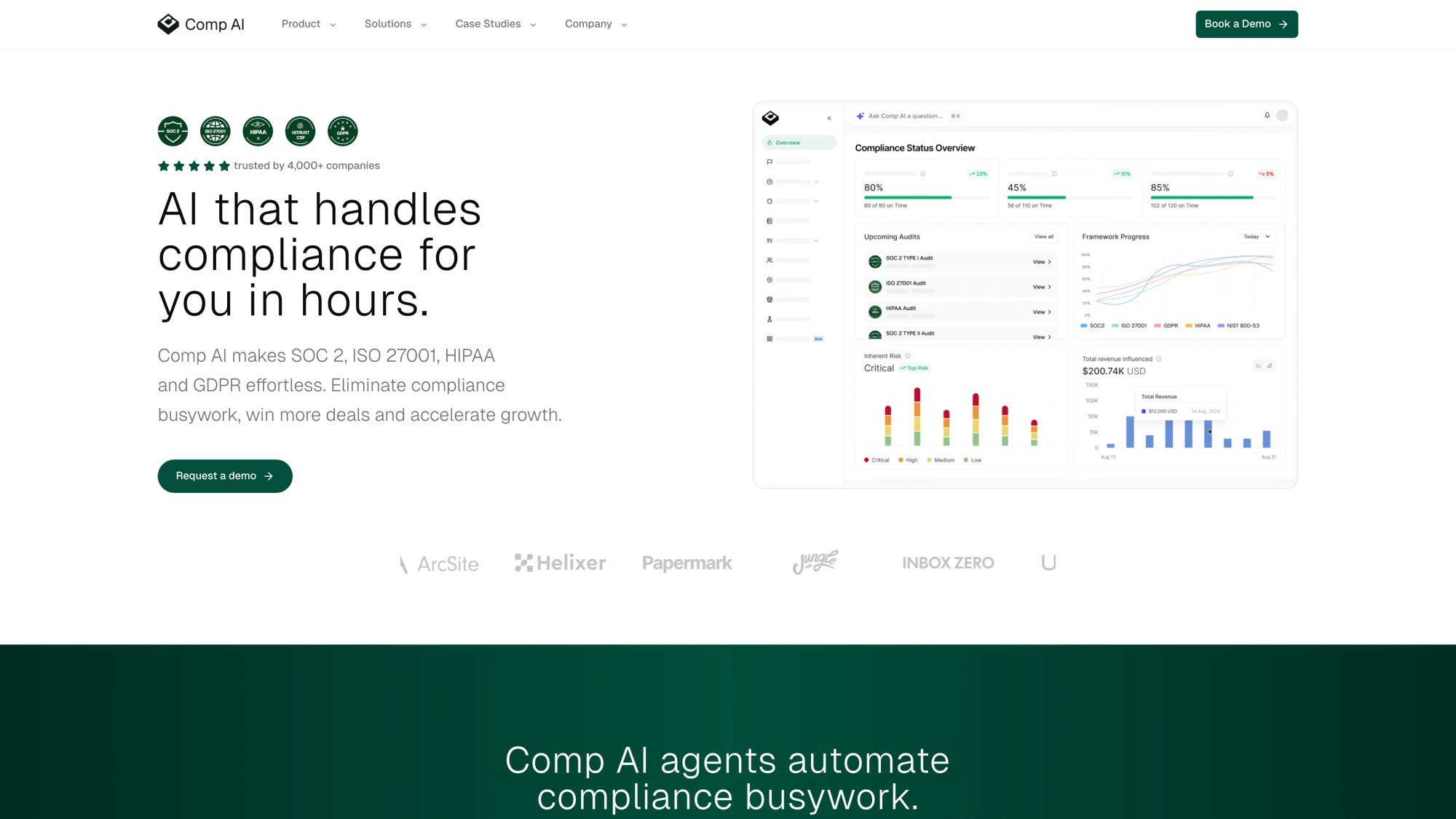
Our AI agents connect to your existing systems (100+ integrations) and automatically collect the evidence auditors need. No more screenshot scavenger hunts. No more spreadsheet nightmares. The automated evidence collection system gathers configurations, access logs, and documentation while you focus on running your business.
Our Done-For-You Compliance Service
SOC 2 shouldn't require you to become a compliance expert. Our team works alongside you through dedicated Slack support, handling the complexity so you don't have to. One customer described it as having "a virtual compliance team" that responds in minutes, not days.
How Fast Can You Actually Get Certified?
\-> Audit-ready in 24 hours
\-> Full SOC 2 certification in under 4 weeks
\-> Type II observation period starts immediately
These aren't aspirational targets. They're what our customers consistently achieve. Persona AI's CTO put it simply: "We were only 30% done after months with another platform. We switched to Comp AI and got compliant in under a week."
What Is Our Success Rate?
Every customer who has completed the process with us has passed their audit. We're confident enough in our approach to offer a money-back guarantee. If you follow our process and don't pass, we refund your investment. If you've experienced challenges with a previous attempt, our failed SOC 2 audit recovery program can help you get back on track.
How Much Does Comp AI Cost?
Price with Comp AI: Starting at $3,000 (including audit)
Price with traditional consultants: $25,000-$50,000+
No hidden fees. No surprise charges at audit time. No annual contracts forcing you into long-term commitments. Estimate your costs before you commit.
What Else Is Included Beyond SOC 2?
SOC 2 is just the beginning. Our compliance automation platform includes:
- Trust Center: A real-time portal showing your compliance status, automatically updated
- AI Questionnaire Responses: When prospects send security questionnaires, our AI drafts responses in minutes using your policies and controls
- Continuous Monitoring: Stay compliant year-round, not just during audit season
- Multi-Framework Support: 25+ frameworks supported, so expanding to ISO 27001, HIPAA, or GDPR uses the same platform
Your Step-by-Step SOC 2 Timeline
If you've determined that now is the time for SOC 2, here's what the process looks like with modern tools:
Week 1: Kickoff and Integration
- Connect your systems to the compliance platform
- AI agents begin evidence collection
- Identify any gaps in current controls
Weeks 2-3: Remediation and Documentation
- Address identified gaps (with guided remediation)
- Generate required policies (AI-assisted)
- Complete control implementation
Week 4: Audit Readiness
- Review evidence package
- Engage pre-vetted auditor
- Begin audit process
Audit Completion: Type I Report Issued
After Type I, your observation period for Type II begins immediately. You're already in compliance mode, so there's no additional preparation needed.
The entire process, from deciding to start to holding your Type I report, can happen in under a month. That's a dramatic change from the 6 to 12 month timelines that used to be standard.
Book a demo to see exactly how the process works for your specific situation.
Frequently Asked Questions About SOC 2 Timing
When Is It Too Early to Get SOC 2?
If you're pre-product-market fit, focused purely on consumer products, or have no enterprise sales plans for the foreseeable future, you can likely wait. But if you're B2B, handling sensitive data, or planning to move upmarket, earlier is almost always better than later. The cost of having SOC 2 "too early" is minimal compared to the cost of not having it when you need it.
How Much Does SOC 2 Certification Cost?
Traditional approaches with consultants and separate auditors can run $25,000 to $50,000 or more. Modern automated platforms have dramatically reduced this. With Comp AI, pricing starts at $3,000 including the audit, with no hidden fees or annual contracts.
How Long Does the SOC 2 Process Take?
Traditional timelines run 6 to 12 months. With automated platforms and AI-powered evidence collection, you can be audit-ready in as little as 24 hours and certified in under 4 weeks. The biggest factors are how many gaps you need to remediate and how quickly your team can implement any required changes.
Should You Get Type 1 or Type 2 First?
Start with Type I. It's faster to obtain and satisfies most initial enterprise vendor requirements. Then use the observation period (minimum 3 months) to build toward Type II. This approach gets you into enterprise conversations quickly while establishing the foundation for the stronger credential.
What If an Enterprise Asks for SOC 2 and You Don't Have It?
You have three options: (1) Ask if they'll accept a SOC 2 "in progress" status with a commitment date, (2) rush to get certified if timeline allows, or (3) potentially lose the deal. The best strategy is to avoid this situation entirely by getting certified before you're actively pursuing enterprise sales.
Can You Do SOC 2 Yourself Without a Platform?
Technically yes, but it's rarely advisable. DIY compliance requires deep expertise, significant time investment (often 500+ hours), and creates ongoing maintenance burden. The cost savings versus using a modern platform are minimal, and the risk of mistakes or audit failures is much higher. Most companies find that automation tools pay for themselves through time savings alone.
What's the Difference Between SOC 2 and ISO 27001?
SOC 2 is the standard for North American B2B software companies and focuses on trust service criteria. ISO 27001 is an international standard focused on information security management systems. Many companies eventually need both, especially if they sell globally. The good news: with modern platforms, much of the work overlaps. Comp AI supports both (and 23 other frameworks) from a single platform. For a detailed breakdown, see our ISO 27001 vs SOC 2 comparison.
How Do You Maintain Compliance After Certification?
SOC 2 isn't one-and-done. You'll need annual audits and continuous adherence to your controls. Modern platforms make this dramatically easier through automated evidence collection and continuous monitoring. What used to require dedicated compliance staff can now run largely on autopilot, with alerts when something needs attention.
The question isn't whether you'll eventually need SOC 2. For most B2B software companies, the answer is yes. The question is whether you'll have it when opportunity knocks, or whether you'll be scrambling to catch up while competitors close the deals you should have won.
If you're seeing the signs, if enterprise prospects are asking questions, if competitors are flashing their compliance badges, if your growth trajectory points upmarket, then the time to act is now.
And with modern tools that compress months into weeks, there's no reason to let compliance be the thing that slows your growth.
Share this article
Help others discover this content
More from Compliance Hub
Explore more insights and stay ahead of regulatory requirements.